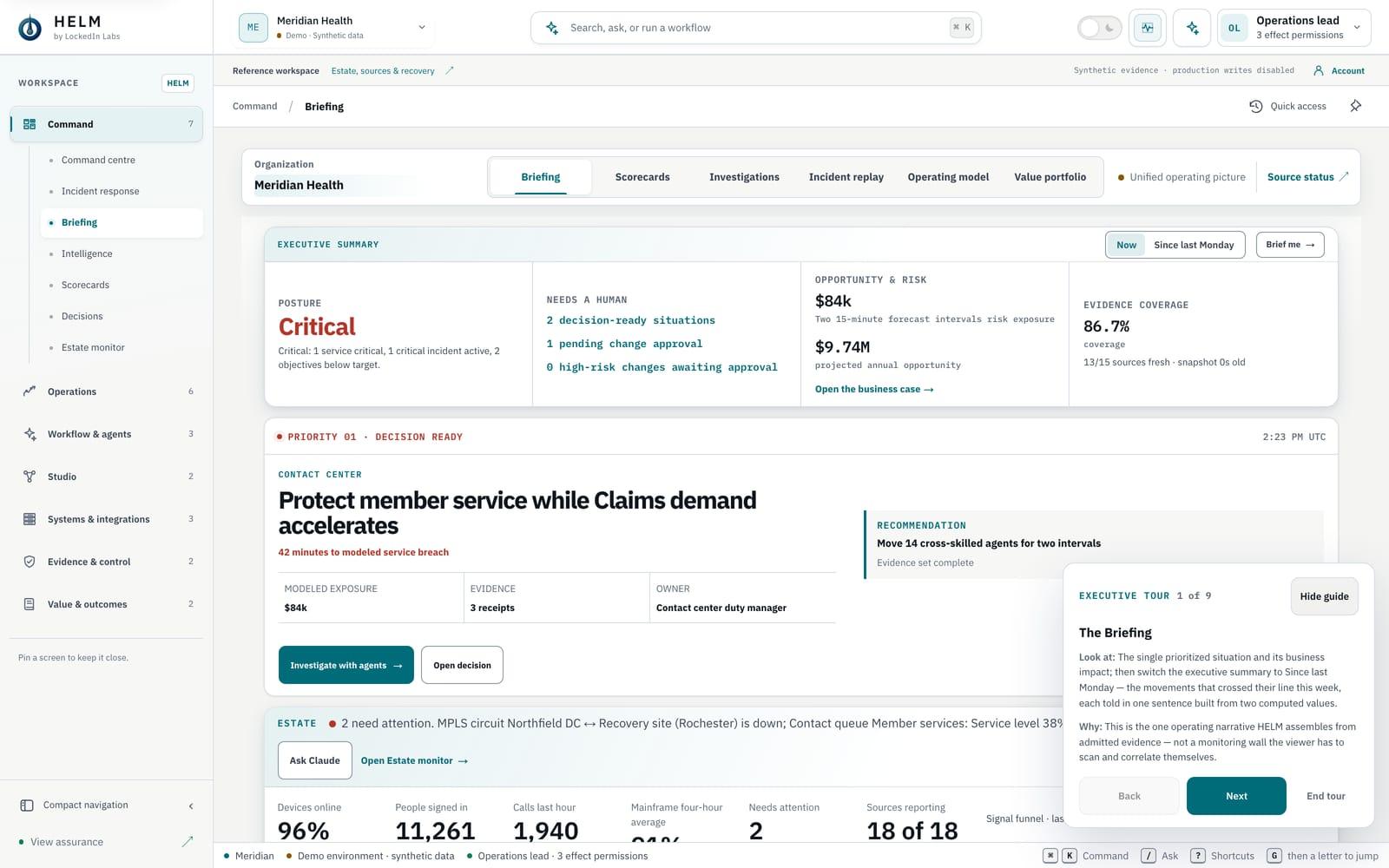
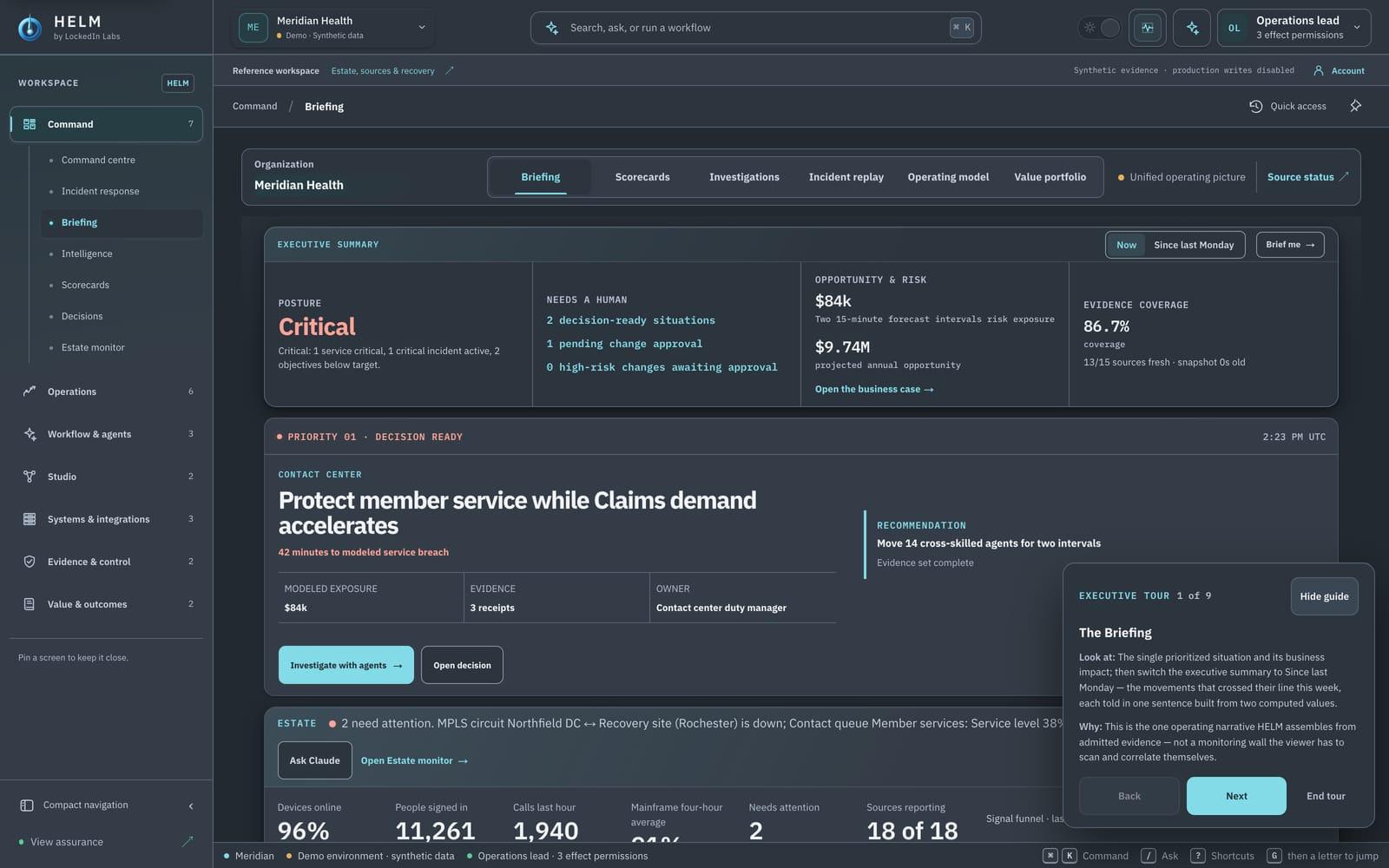
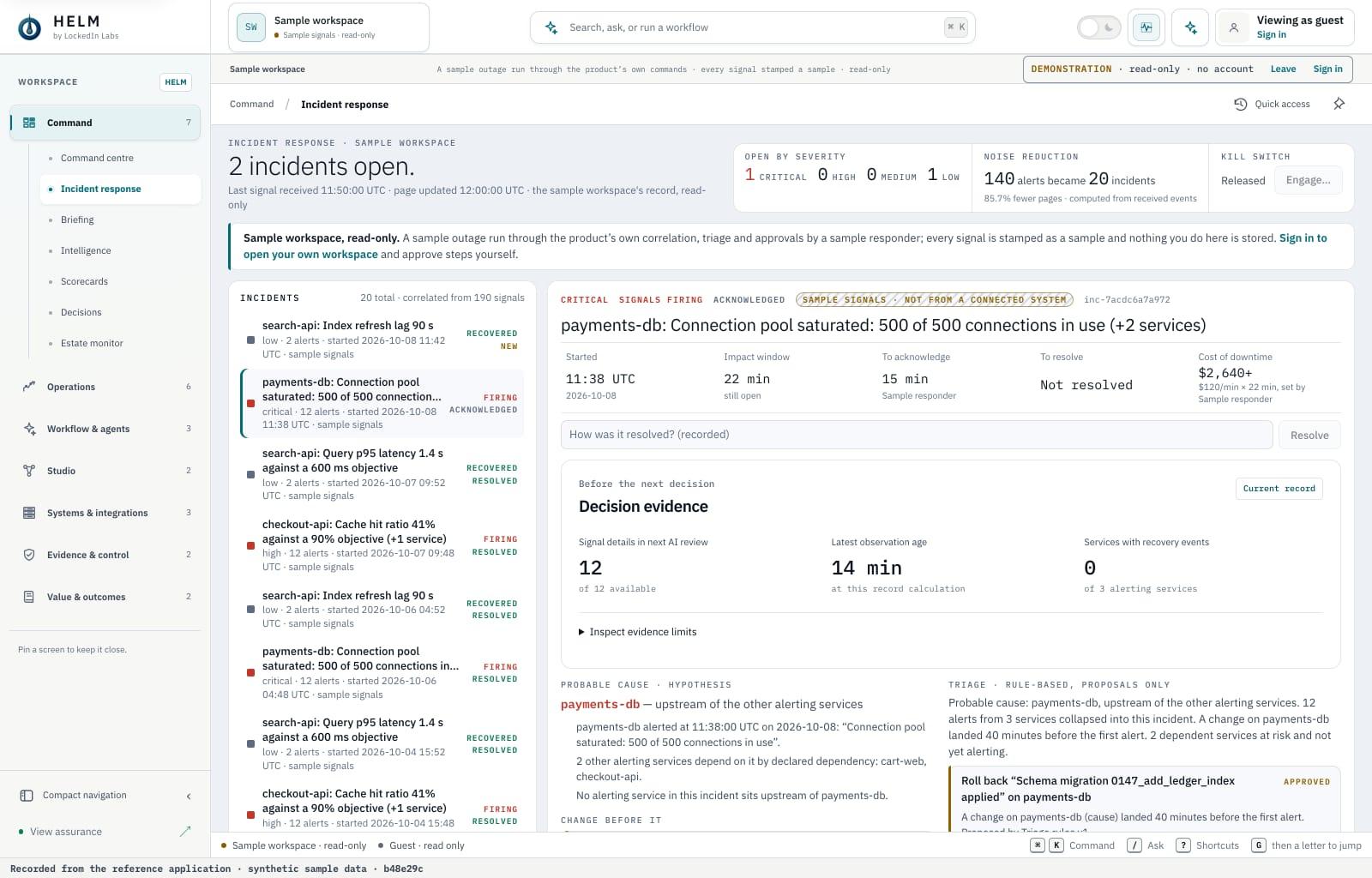
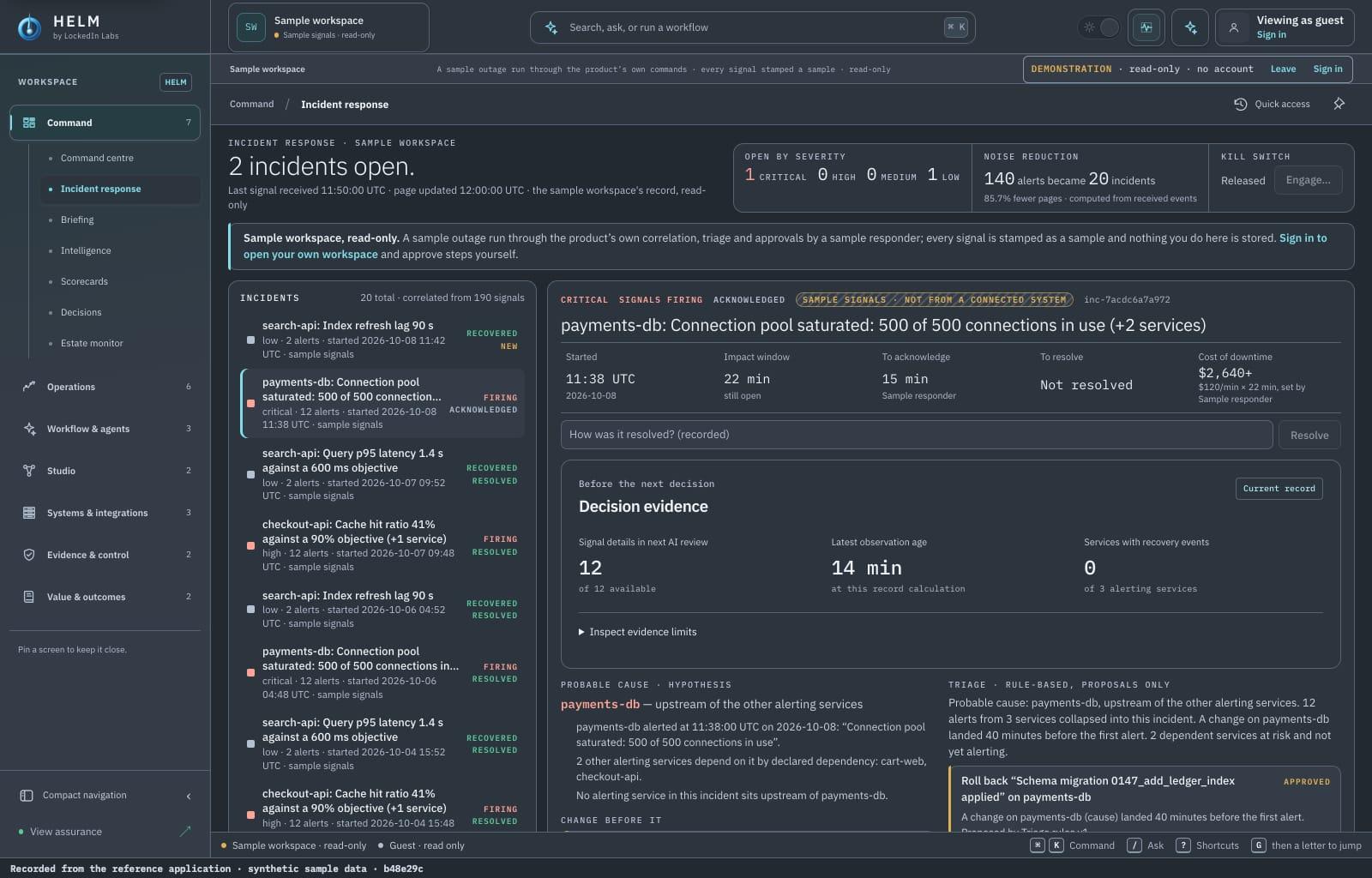
Every claim here is tied to a release you can inspect.
What HELM by LockedIn Labs does today, recorded from the reference application on a synthetic health plan — and what a customer deployment still has to prove. Shipped capability, activation gates and the business case are kept apart, and each one says what it rests on.
A dated capability record. It separates shipped implementation from customer activation.
Reviewed release
v0.44.1 ·
Source reviewed
3b50275 (code)Inspect release identity and scope
A released evaluation platform with source-backed questions, governed workflows, shared-board controls and a native workspace experience.
Protected CI and retained security analysis
Scanned, signed deployment image
Desktop/mobile administrator acceptance
Native database and restore checks
The hosted application uses synthetic reference data. Customer identity, approved sources, providers and operational acceptance require a separate activation. Customer outcomes are not yet established.
This record moves with a release tag; work merged since appears here at the next release.
v0.28–v0.33
Evidence before interpretation
Defined source answers for claims, technical reports, AI usage and reported costs, plus inspectable workflow results and source-pinned claims review. Exact facts remain source-authored; model interpretation requires review and customer processing approval.
v0.38
From a spoken question to an operating view
Governed voice input, reviewable registered questions and saved query boards join interactive agent, network and contact-center reference views. Real microphone, voice-provider and customer-source acceptance remain target-specific.
v0.41
Technical answers with their source attached
Reported p95 latency and error rate bring the supported question types to five. Operators select a source and search window, inspect freshness and receipts, then pin the query. Source-reported values remain distinct from window-wide aggregates or general conversational analytics.
v0.42
A workspace that stays with the operator
Contextual navigation, pinned and recent screens, compact mode and a keyboard command launcher make the application easier to move through. Destinations remain filtered by organization and role; preferences grant no additional authority.
v0.43
Service evidence and tested recovery foundations
Approved service mappings bind reported measurements to exact source receipts. A disposable PostgreSQL restore drill verifies the application catalog, isolation, audit and workflow recovery. This is engineering evidence; customer feeds, browser identity and target failover acceptance remain open.
v0.44.1
Share the view while preserving authority
Owner, editor and viewer board roles, short-lived room access, revocation and source rechecks are implemented and tested. The hosted reference explains activation and issues no customer room grants. Room links now retain their destination through sign-in; real display acceptance remains target-specific.
Archive
v0.34 executive deck, under its earlier product name
Activation
Make enterprise activation concrete.
Every environment maps the product core, integration packages, authority model, acceptance evidence, and rollback posture in one release-bound contract.
0:00 / 0:46
Keyboard: Space or K plays and pauses, C turns captions on or off, left and right arrows move 5 seconds, Home and End jump to the start or end, 1 to 3 jump to a chapter, F opens full size.
Receipts
The audit record, the access ledger and the governed action record each end in a hash chain that is recomputed in front of you; the action record names its approver by role and says what it cannot reach.
0:46 · recorded from the reference application · synthetic sample data · Recorded from HELM by LockedIn Labs.
Transcript
Each audit entry is written before the change it records, and sealed;
These are measurable value hypotheses, not realized ROI claims. Agree the baseline, comparison window, attribution and acceptance owner; subtract platform, integration, AI and operating costs without counting the same benefit twice.
Customer proof
The next investment is customer proof.
Advance from a working platform to an accepted payer workflow, then demonstrate repeatable value. Customer activation and outcomes require separate acceptance.
Gate 1Customer evidence required
Activate one payer workflow
Approve the queue population, source semantics, processing policy and operating owner. Reconcile customer captures before putting them in front of a decision maker.
Gate 2Customer evidence required
Prove the operating decision
Connect the review to a named human decision and an accepted response path. Measure evidence quality, handoff effort and operational guardrails.
Gate 3Commercial evidence required
Earn repeatable expansion
Measure the accepted outcome and total cost to serve. Reuse the pack on another workflow and demonstrate lower activation effort before expanding the product scope.
The product scope, reviewed release identity and customer acceptance requirements are included in the Earlier AI Ops executive brief ↓.
Operating method
Build reusable methods from reviewed evidence.
Reusable operating intelligence compounds only after evidence, review, versioning, and outcome verification.
Evidence becomes a method, and a method becomes a verified lesson, only after review. Reviewed, policy-compatible method artifacts can be proposed for reuse.
Credentials
never written into plans or receipts
Customer data
tenant-scoped; model memory is blocked for PHI-classified context
Learning
reviewed promotion only; no automatic cross-customer training